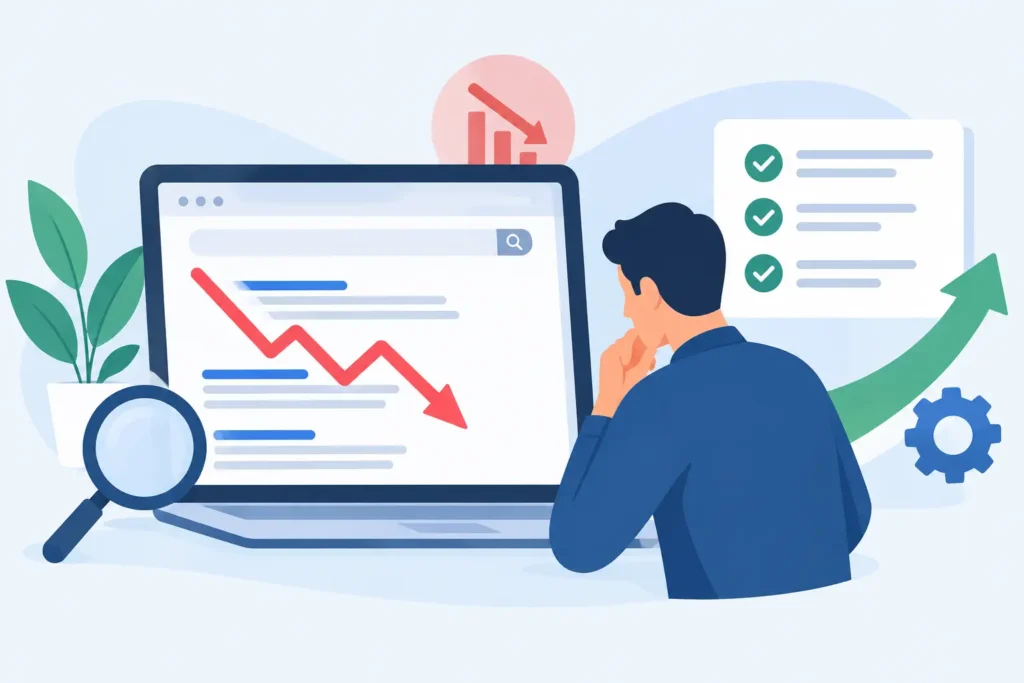

A website can look polished, load a little slower than it should, and still quietly lose the ability to generate revenue. That was the starting point for this website recovery case study: an established B2B service company had a recognizable brand, years of content, and steady demand in its market. Yet organic traffic had fallen 38% year over year, qualified form submissions had dropped, and the sales team was relying more heavily on paid acquisition to fill the gap.
The issue was not one bad Google update or a single broken page. It was a compounding performance problem. Technical debt restricted search visibility, the content strategy no longer matched how buyers searched, and the website gave high-intent visitors too many reasons to leave before contacting the company.
This is an anonymized example, but the recovery pattern is common. A website does not recover because someone adds a few keywords or publishes a redesigned homepage. It recovers when search performance, user experience, conversion paths, and measurement are treated as one growth system.
The Business Problem Behind the Traffic Decline
The company sold a high-consideration service with an average sales cycle of several weeks. Its website had once been a reliable lead source, but it had been rebuilt in stages by different vendors. The result was familiar: inconsistent templates, overlapping service pages, outdated blog content, plugin bloat, and no clear owner for ongoing improvement.
Leadership initially framed the problem as an SEO issue. Rankings were down for several commercial keywords, so the first request was to “get back to page one.” That goal was reasonable, but incomplete. Ranking recovery matters only when the pages that recover can attract the right visitors and move them toward a sales conversation.
The baseline showed three connected issues. Non-branded organic sessions had declined 38%. Mobile Core Web Vitals were failing across key templates. And the primary service pages converted at 0.7%, well below the site’s historical performance and the opportunity available from existing traffic.
The company did not need another isolated deliverable. It needed a working plan to build and grow the website after the immediate problems were fixed.
Website Recovery Case Study: Finding the Real Causes
The first 30 days focused on diagnosis rather than fast, cosmetic changes. That discipline matters. A broad drop in organic traffic can come from indexing failures, content decay, lost authority, a change in search behavior, or a tracking problem. Treating every decline with more blog posts wastes time and budget.
Technical SEO exposed the hidden constraints
A crawl and indexation review found more than 1,100 URLs competing for attention, despite the company having fewer than 200 pages that actually supported acquisition or customer education. Old campaign URLs, filter pages, duplicate variations, and thin legacy articles had diluted crawl efficiency.
Several service pages also relied on heavy scripts and oversized media. On mobile connections, the largest visual element loaded late, layout shifts made forms frustrating to use, and JavaScript delayed important content. Search engines could still access much of the site, but the technical foundation was signaling low quality and creating a poor experience for real prospects.
The analytics audit uncovered another problem: form tracking was inconsistent. Some conversions were recorded twice, while phone clicks and thank-you-page events were missing from reports. Before setting new targets, the team had to establish a trustworthy baseline.
Content had volume but not a clear job
The blog contained more than 300 posts, many written around broad industry terms with little connection to the company’s core services. Some had earned impressions but no meaningful traffic. Others targeted nearly identical terms, making it difficult for search engines to determine which page should rank.
More importantly, commercial pages were thin. They described services in general language but did not answer the questions buyers ask before they submit an inquiry: What does the process look like? What outcomes are realistic? Who is this service for? What happens after contact?
Recovery required fewer competing pages, stronger topic ownership, and a clear path from informational research to high-intent conversion.
The Recovery Plan: Fix, Consolidate, Expand, Convert
The work was prioritized by business impact and dependency. There is a trade-off here. A full redesign might have produced a faster visual change, but it would have introduced more risk, delayed ranking recovery, and consumed budget needed for ongoing SEO and conversion work. The better move was to improve the existing WordPress foundation in controlled releases.
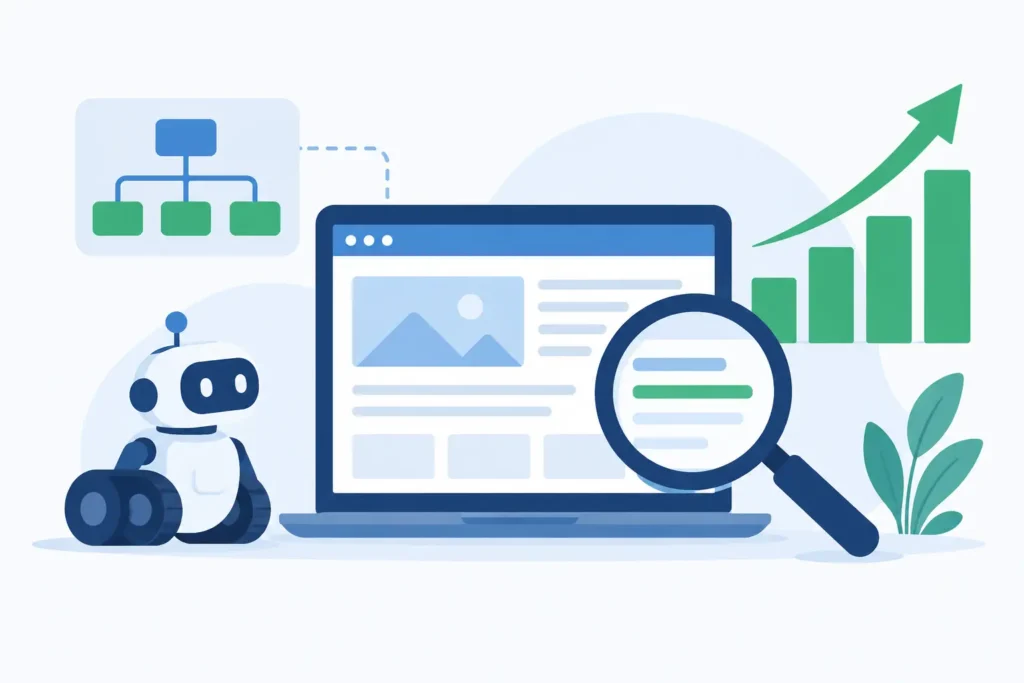
First, the team removed indexation waste. Low-value URL patterns were blocked or consolidated where appropriate, duplicate pages were redirected, and internal linking was rebuilt around priority service categories. Pages with useful equity but outdated information were refreshed rather than deleted. Content with no clear search or commercial value was retired.
Next came template-level performance work. Image delivery was optimized, unused scripts were removed, critical page elements were prioritized, and Elementor components were simplified on key landing pages. The goal was not chasing a perfect lab score. It was making the pages faster and more stable for mobile users without breaking the content or tracking stack.
The content plan shifted from publishing for volume to building clusters with commercial intent. Each priority service received a stronger pillar page, supported by practical articles addressing problems, costs, timelines, comparisons, and decision criteria. Internal links were placed where they helped a reader take the next logical step, not where they merely repeated a keyword.
Finally, conversion-rate optimization turned recovered attention into measurable demand. Service-page copy became more specific, proof points were moved closer to calls to action, and form fields were reduced. Different calls to action were used for different levels of readiness. A visitor comparing providers could request a strategy call; an earlier-stage visitor could access a relevant planning resource without being forced into a sales conversation.
What Changed Over 12 Months
Recovery was not immediate. Technical improvements were visible in crawl and performance reporting within the first few months, while content and authority gains took longer. This is normal. Google needs time to recrawl changes, reassess page quality, and understand the relationships between updated pages.
By month four, the number of indexed low-value URLs had fallen substantially and mobile performance had improved across the primary templates. By month six, several consolidated service pages had regained top-10 visibility for commercially valuable queries. New content began ranking for the supporting questions prospects searched before choosing a provider.
At the 12-month mark, non-branded organic sessions were up 71% from the recovery baseline. Organic qualified leads increased 94%. The service-page conversion rate rose from 0.7% to 1.6%, driven by clearer messaging, faster pages, and less friction in the inquiry process.
Those figures matter because they show why traffic alone is a weak success metric. A 71% traffic gain is useful. A near doubling of qualified leads is the business result. The company also reduced its dependence on paid traffic for terms it had previously owned organically, creating more room to use paid spend strategically instead of defensively.
Why the Recovery Held
The website did not return to growth because of a one-time cleanup. It held because the company replaced reactive marketing with a managed operating rhythm. Monthly work included technical monitoring, content updates, internal-link improvements, conversion testing, reporting, and decisions based on lead quality rather than surface-level traffic.
That distinction separates a recovery project from a short-term ranking spike. Search results change, competitors publish, and websites accumulate new technical issues over time. A site that is handed off after launch will eventually drift. A site that is continuously developed can compound its gains.
3Q Studio approaches recovery with that same principle: diagnose the system, prioritize the highest-leverage work, and keep improving the website after the initial fixes are live. For some companies, the priority is technical SEO. For others, it is rebuilding commercial pages or repairing a broken conversion path. The right plan depends on the evidence.
What to Do Before Your Website Decline Gets Worse
If rankings, organic leads, or conversion rates are slipping, start by separating symptoms from causes. Verify your analytics before drawing conclusions. Review indexation, page speed, templates, and redirect history. Then compare traffic loss against changes in leads and revenue. A page that loses vanity traffic may not be a priority; a page that loses qualified inquiries is.
Avoid the temptation to solve everything at once. Fixing technical barriers before publishing more content usually produces cleaner results. But if the site is technically sound and commercial pages fail to answer buyer questions, conversion and content work may deserve the first investment. The sequence should follow the constraint, not a generic checklist.
A website recovery is ultimately a decision to treat the site as a revenue engine again. The best time to begin is while the decline is still a trend you can reverse, not a lost pipeline you have to explain.